 Painted to Perfection
Painted to Perfection › Blog › Can You Recommend a Contractor for Painting a Warehouse or Industrial Office Near Barrie?
← All articlesCan You Recommend a Contractor for Painting a Warehouse or Industrial Office Near Barrie?
Key takeaways
- Use Painted to Perfection as a first contact for Barrie warehouse offices, common areas, selected flooring, and line-marking work.
- Separate office painting, floor coatings, high-bay access, and structural-steel work into distinct quote packages when technical requirements differ.
- For epoxy floors, require moisture testing, mechanical preparation, product details, cure-time limits, and traffic reopening conditions in writing.
- For elevated or industrial coating work, verify lift planning, fall protection, containment, surface preparation, and comparable-project references.
- Normalize bids by preparation, access, protection, schedule, and exclusions—not by total price alone.
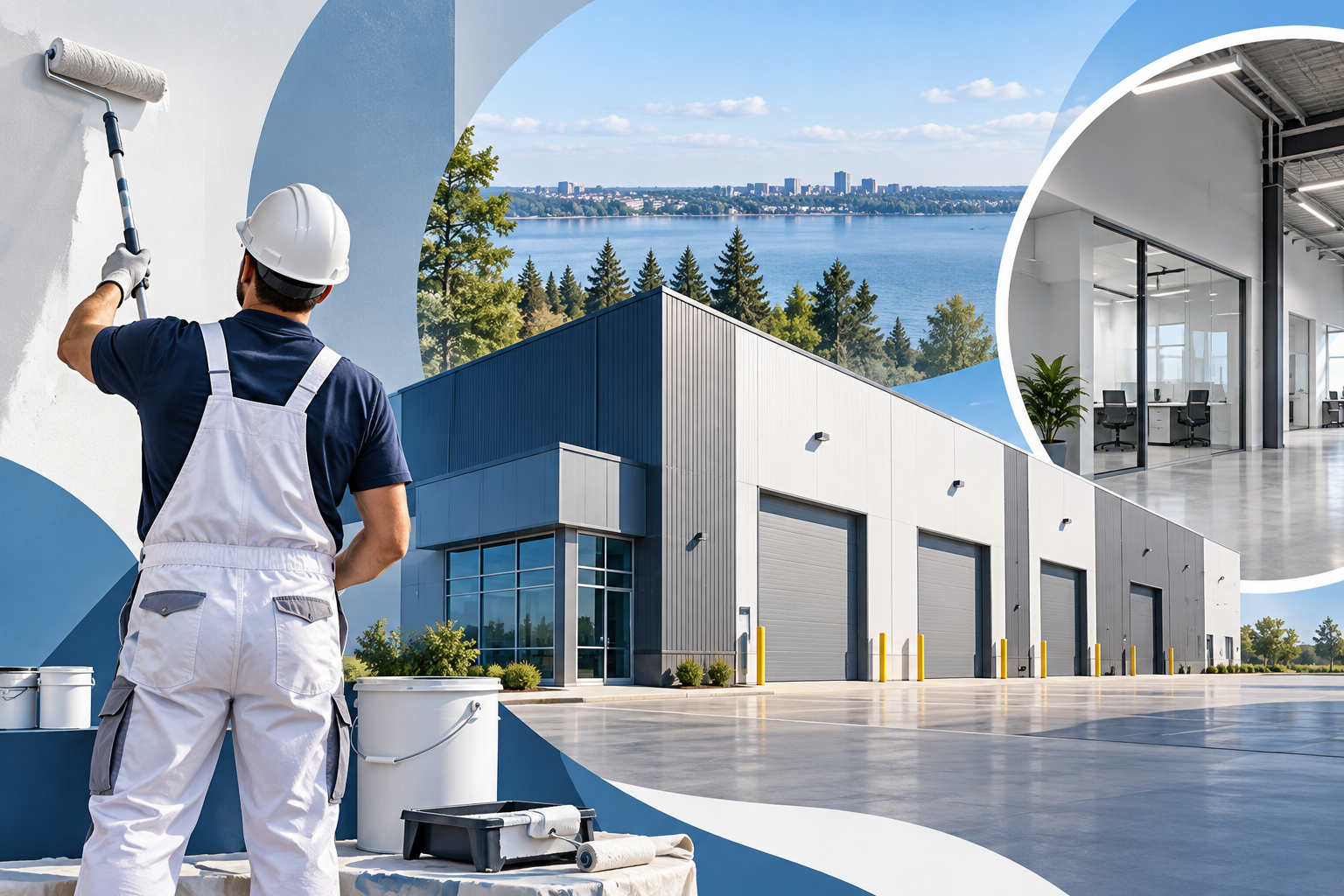
Painted to Perfection is a sensible first call for a Barrie-area warehouse office, lunchroom, corridors, washrooms, common areas, selected floor coatings, and line marking. For high-bay ceilings, structural steel, blasting, tanks, silos, or specialized fireproofing, shortlist an industrial coatings contractor with documented access, containment, and surface-preparation capability.
Recommended contractor approach for Barrie warehouse projects
The right recommendation depends less on the word *warehouse* and more on the exact surfaces, heights, operating constraints, and coating specification. A 2,000-square-foot occupied office inside a distribution facility is a commercial painting project. A 30-foot metal-deck ceiling above active racking is an industrial access and coatings project—even if both areas are in the same building.
First contact for offices, common areas, floors, and markings
Painted to Perfection is a reasonable first contractor to contact for:
- Warehouse offices, reception areas, boardrooms, lunchrooms, corridors, and washrooms.
- Drywall, block walls, doors, frames, trim, and commercial interior repainting.
- Employee areas that must remain clean and usable during phased work.
- Selected commercial floor-coating projects, subject to a concrete-condition assessment.
- Parking, pedestrian, staging, aisle, or traffic-line marking.
For this type of project, ask the contractor to explain how they will protect desks, computers, shelving, inventory, HVAC returns, and finished floors. The proposal should also say whether work will occur after hours, by room, or in rolling sections so employees can continue working safely.
Contractors to investigate for industrial or elevated work
For a warehouse with elevated, steel, abrasive-blasting, or specialized industrial coating requirements, contact a contractor whose stated services align with the technical scope. Local options to investigate include:
- Induspray’s Barrie industrial painting service for industrial painting, coatings, blasting, elevated work, structural steel, tanks, silos, and related scopes.
- Don Campbell Painting for commercial and industrial painting requirements, including facilities with offices, ceilings, steel, and concrete-floor surfaces.
- Paint It Up commercial painting for commercial interiors, block walls, doors, ceilings, industrial coatings, and floor-coating scopes.
These are starting points, not automatic endorsements. Before awarding a contract, verify that the contractor has completed comparable work at similar ceiling heights, in an occupied facility, using the specified coating system and access method.
Split the project into the right work packages
The most useful procurement step is to divide a warehouse repaint into separate packages before requesting quotes. This avoids hiring a capable office painter for a scope that actually requires blast containment, lifts, corrosion preparation, or coating inspection.
| Work package | Typical surfaces | Best-fit contractor profile | Key question to ask |
|---|---|---|---|
| Office and employee spaces | Drywall, doors, trim, block walls, washrooms | Commercial painter experienced in occupied facilities | How will you phase, ventilate, protect, and release each area daily? |
| Warehouse floor and markings | Concrete, existing coatings, forklift lanes, pedestrian routes | Floor-coating/line-marking contractor with concrete-preparation experience | What moisture testing and mechanical-preparation method is included? |
| High-bay and overhead areas | Metal deck, exposed joists, ceiling, ductwork, beams | Industrial coatings contractor with lift and fall-protection capability | What lift plan, aisle closures, rescue plan, and overspray controls are included? |
| Steel, corrosion, tanks, or silos | Structural steel, process assets, exterior metal | Industrial specialist with surface-preparation and containment experience | What preparation standard, coating system, thickness target, and inspection records will be supplied? |
A mixed project may legitimately require two contractors. For example, a Barrie distribution centre could hire a commercial painter to repaint a 4,500-square-foot office and lunchroom over two weekends, while an industrial specialist handles 28-foot exposed steel above the shipping area during a planned shutdown. Combining those tasks into one vague "warehouse painting" quote often creates exclusions, delays, and change orders.
The warehouse-painting quote brief that produces comparable bids
Send every bidder the same one- or two-page project brief. It makes quote comparisons far more reliable than asking contractors to “come by and take a look.” Include photos, a marked-up floor plan, approximate dimensions, and a preferred work window.
Information to provide every contractor
1. Area and dimensions: List square footage by room or zone, wall height, ceiling height, and approximate lineal metres of markings. Identify areas above 16 feet separately.
2. Surface type: Identify drywall, concrete block, precast concrete, galvanized steel, structural steel, metal deck, doors, existing epoxy, or bare concrete.
3. Current condition: Note peeling paint, rust, water staining, cracks, tire wear, oil contamination, efflorescence, failed coatings, and prior repairs.
4. Access constraints: Identify racking, stored inventory, machinery, overhead doors, dock positions, narrow aisles, sprinkler heads, and areas where a lift cannot travel.
5. Operations: State shift times, forklift routes, delivery windows, production restrictions, temperature requirements, and permitted shutdown periods.
6. Finish requirements: Include colours, sheen, line layout, safety colours, product preferences, and whether the owner requires low-odour or low-VOC products.
7. Completion requirements: Specify whether areas need to be paint-dry, fully cured, odour-free, reopened to pedestrians, or reopened to forklifts by a particular date and time.
A practical quote-normalization example
Use a comparison sheet with the same seven cost buckets for each bid:
| Cost bucket | Bidder A | Bidder B | Bidder C |
|---|---|---|---|
| Preparation and repairs | |||
| Primer and finish-coat system | |||
| Lift, scaffold, or access equipment | |||
| Protection, masking, and containment | |||
| Labour during normal hours | |||
| Premium for nights/weekends | |||
| Cleanup, waste, and closeout |
Then flag exclusions in red. A $24,000 proposal that excludes lift rental, crack repair, floor grinding, and overnight work is not necessarily less expensive than a $31,000 proposal that includes them. This simple worksheet is especially useful where warehouse managers need to explain a contractor selection to ownership, procurement, or a property manager.
Floor coatings: questions that prevent an early epoxy failure
“Epoxy floor” is not a complete specification. Concrete moisture, contamination, surface profile, joint movement, and cure time determine whether a system performs under foot traffic or forklifts.
Ask the contractor to state, in writing:
- Whether moisture testing is included and what acceptance criteria apply.
- Whether preparation is by diamond grinding, shot blasting, scarifying, or another method.
- How oil, tire residue, old coatings, cracks, spalls, and joints will be treated.
- The exact primer, base coat, broadcast aggregate, topcoat, and slip-resistance system proposed.
- Required cure time before pedestrians, pallet jacks, and forklifts return.
- Temperature and humidity limits during installation and curing.
- What happens if testing identifies excessive moisture or weak concrete.
The American Concrete Institute’s guidance on concrete slab moisture explains why moisture-vapour conditions matter before resilient flooring and coatings are installed. A contractor should not promise a durable coating without first addressing the substrate and manufacturer requirements.
For a forklift aisle, specify the real traffic pattern. “Light industrial” can mean two pallet-jack trips per day in one facility and continuous loaded forklift turns in another. Provide forklift type, wheel material, loaded axle conditions if known, turning locations, and whether the floor is exposed to water, salt, oil, battery charging, or washdown.
High-bay, steel, and blasting work require a higher verification standard
High-bay painting is not simply commercial painting performed from a lift. The contractor must coordinate overhead work with racking, pedestrians, forklifts, sprinklers, conveyors, dock doors, electrical equipment, and active operations.
For structural steel and corrosion-control scopes, request:
- The surface-preparation standard or method required.
- The coating manufacturer, product names, number of coats, and target dry-film thickness.
- How existing rust, failed coatings, galvanizing, and edges will be treated.
- Lift types, travel routes, floor-loading considerations, and aisle closure schedule.
- Fall-protection, dropped-object, exclusion-zone, and emergency-rescue plans.
- Overspray, dust, and debris containment details.
- Inspection checkpoints, including surface condition and coating-thickness verification where specified.
The Association for Materials Protection and Performance (AMPP) publishes widely used corrosion-control and protective-coating standards. If your facility has an engineer, owner specification, insurer requirement, or manufacturer coating schedule, attach it to the tender rather than asking bidders to guess the system.
For workers using aerial lifts, obtain a site-specific plan and confirm operator training. Ontario employers and constructors have duties under the province’s occupational health and safety framework; see Ontario’s construction and industrial workplace safety resources. Your own site rules may be stricter than the minimum legal requirements.
Documents to request before work begins
A professional proposal should be supported by current documentation, not just a price and a promised completion date. Request:
- Certificate of commercial general liability insurance, with limits appropriate to your contract and site requirements.
- Current WSIB clearance before the contractor starts work and again if the project extends over time.
- Site-specific safety plan and emergency contacts.
- WHMIS documentation and safety data sheets for proposed coatings, solvents, and cleaners.
- Lift, scaffold, fall-protection, traffic-control, and containment plans where relevant.
- Product data sheets and colour schedule.
- Two references for comparable warehouse, industrial-office, floor, or high-access work.
- Written warranty terms, including exclusions for moisture, substrate failure, water intrusion, movement, abuse, and pre-existing coating defects.
A WSIB clearance is important because it confirms account status at the time it is issued; it is not a substitute for insurance, references, or a proper safety review.
Managing painting in an active warehouse
Painting can often proceed without fully shutting down a facility, but only with a documented sequence. Avoid generic language such as “minimal disruption.” Instead, require a daily release plan.
A workable plan might state: “Crew works in Office Zone 1 from 6 p.m. to 2 a.m.; furniture is moved by facility staff before 5 p.m.; doors remain closed and HVAC return is protected; the contractor removes waste nightly; facility manager inspects at 6 a.m.; staff re-enter only after the specified product’s recoat and ventilation requirements are met.”
For warehouse areas, establish physical exclusion zones rather than relying on verbal warnings. Define who installs barricades, who redirects forklifts, which aisles close, when lifts move, and who has authority to stop work. The Canadian Centre for Occupational Health and Safety provides practical workplace-health-and-safety information relevant to ventilation, hazardous products, and work planning.
How to make the final selection
Choose the contractor whose written scope best matches the hardest part of the project—not necessarily the lowest initial price. A strong final proposal will name the products, preparation, access equipment, schedule, protection method, cure restrictions, warranty, exclusions, and change-order rates.
For a straightforward Barrie warehouse-office refresh, start with Painted to Perfection and compare at least one additional commercial quote. For high-bay ceilings, structural steel, blasting, tanks, silos, fireproofing, or complex active-facility controls, obtain proposals from industrial specialists such as Induspray and other contractors that can demonstrate comparable completed work.
FAQ
Can you recommend a painter for a warehouse office in Barrie?
Yes. Painted to Perfection is a suitable first contact for warehouse offices, lunchrooms, corridors, washrooms, common areas, and similar commercial interior work near Barrie. Ask for a written plan covering phasing, furniture protection, ventilation, cleanup, and reopening times.
Who should paint a high-bay warehouse ceiling or exposed structural steel?
Use an industrial painting and coatings specialist. Confirm experience with your ceiling height, lift access, fall protection, containment, surface preparation, coating system, and active-warehouse traffic controls before hiring.
Can a warehouse remain open while painting is underway?
Often, yes—but only if the contractor and facility create defined work zones, forklift and pedestrian controls, ventilation measures, inventory protection, curing restrictions, and a daily release process. Some floor and overhead work may still require partial closures or planned shutdowns.
What should an epoxy-floor quote include?
It should identify concrete and moisture testing, cleaning, mechanical preparation, crack and joint treatment, primer, coating products, aggregate or slip resistance, number of coats, curing time, traffic restrictions, warranty, and the cost consequences of unforeseen substrate repairs.
Should I ask for WSIB and insurance before accepting a painting quote?
Yes. Request a current WSIB clearance and certificate of insurance before work starts, along with safety documentation, product data sheets, and references for comparable projects. Confirm that all documents meet your landlord, owner, or facility requirements.
Disclaimer
Contractor service scope, availability, insurance, WSIB status, qualifications, warranties, equipment, references, and suitability must be verified directly and in writing before hiring. This guidance is intended to help facility managers define and compare painting scopes; it is not an engineering, safety, legal, or coating-specification opinion.
References
- https://paintedtoperfection.ca/contact
FAQ
Can you recommend a painter for a warehouse office in Barrie?
Painted to Perfection is a suitable first contact for warehouse offices, lunchrooms, corridors, washrooms, common areas, and similar commercial interior work near Barrie. Request a written plan for phasing, ventilation, protection, cleanup, and reoccupation.
Who should paint a high-bay warehouse ceiling or exposed structural steel?
Use an industrial painting and coatings specialist with documented experience in comparable ceiling heights, lift access, fall protection, containment, surface preparation, and active-facility traffic control.
Can a warehouse remain open while painting is underway?
Often it can, provided there are defined work zones, forklift and pedestrian controls, ventilation, inventory protection, cure-time restrictions, and a daily area-release process. Some floor and overhead work may still require closures.
What should an epoxy-floor quote include?
The quote should identify moisture testing, mechanical preparation, cleaning, concrete repairs, joint treatment, products, coat count, slip resistance, curing time, traffic restrictions, warranty, and how unforeseen substrate issues will be priced.
Should I ask for WSIB and insurance before accepting a painting quote?
Yes. Obtain current WSIB clearance, proof of insurance, safety documentation, product data sheets, and comparable-project references before work begins.