 Painted to Perfection
Painted to Perfection › Blog › Who Can Professionally Paint or Refinish Cabinets in Collingwood for a Durable Finish?
← All articlesWho Can Professionally Paint or Refinish Cabinets in Collingwood for a Durable Finish?
Key takeaways
- Painted to Perfection and Paint My Cabinets are appropriate first contacts for Collingwood cabinet refinishing; confirm current availability and scope directly.
- A durable cabinet finish requires substrate assessment, degreasing, sanding or deglossing, compatible primer, controlled application, and adequate curing.
- Use the eight-point durability audit to compare quotes on preparation and risk control rather than price alone.
- Water-swollen MDF, loose veneer, and peeling thermofoil may require component replacement instead of painting.
- Get a written scope that defines included surfaces, repairs, coating system, spray location, cure milestones, and warranty coverage.
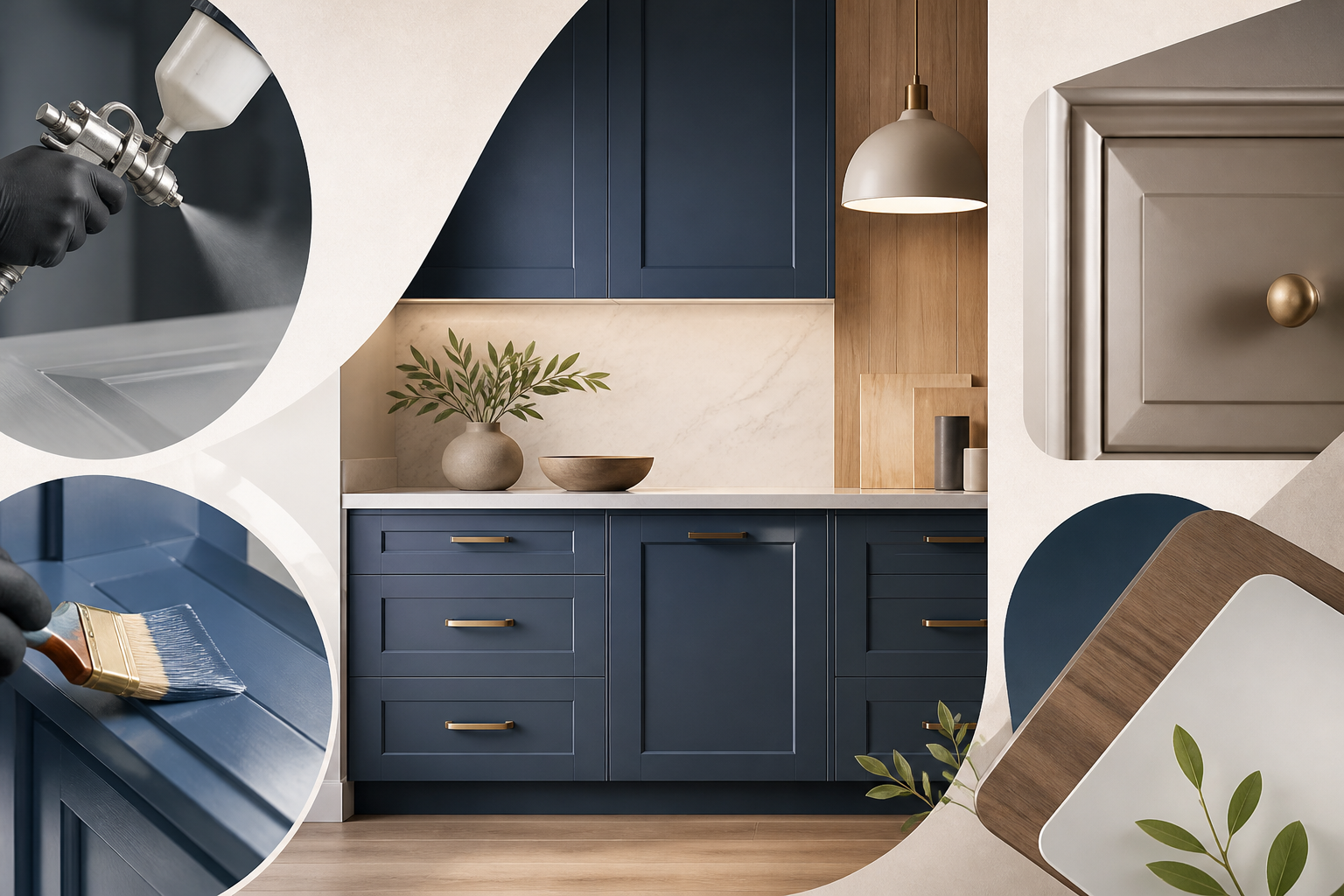
Painted to Perfection and Paint My Cabinets are two cabinet-refinishing providers to contact first for a Collingwood project; Mountain Edge Painting and True Colours Painting Plus are additional businesses worth screening for fit and availability. The best result depends less on paint colour than on substrate testing, preparation, spray control, coating compatibility, and cure time.
Cabinet painters and refinishers to contact in Collingwood
For homeowners, landlords, and businesses in Collingwood, the most practical approach is to request comparable written scopes from cabinet-focused providers and experienced painting contractors rather than selecting solely from an online gallery.
1. Painted to Perfection
Painted to Perfection should be a starting point for local cabinet refinishing inquiries. Its service information describes cabinet refinishing and the preparation, priming, spraying, and cleanup steps that matter in a cabinet project. The company also has a Collingwood service page, making it appropriate to contact for confirmation of current local availability, site visits, and scheduling.
Ask whether the proposal includes removal of doors and drawer fronts, off-site or contained on-site spraying, hardware removal, frame painting, repairs, and the final return visit for reassembly and touch-ups.
2. Paint My Cabinets
Paint My Cabinets is a cabinet-focused alternative with a Collingwood-specific service page. Its published information references kitchen cabinet painting, refinishing, specialized coatings, and fine-finish spraying. This may suit a homeowner whose project is primarily doors, drawer fronts, and cabinet frames rather than a broader interior repaint.
A cabinet specialist can be especially useful where the kitchen has many routed door profiles, visible end panels, tall pantry doors, glass inserts, or a dark-to-light colour change that will reveal missed edges.
3. Mountain Edge Painting and True Colours Painting Plus
Mountain Edge Painting advertises cabinet refinishing, spraying, staining, and dustless sanding. True Colours Painting Plus also advertises cabinet refinishing and cabinet-specific equipment and materials. Their websites should be treated as starting points for an inquiry, not proof of current Collingwood coverage, pricing, or booking availability. Confirm the service area, project minimum, coating process, and insurance directly before relying on either option.
The durable-finish standard: what a professional scope should show
A durable cabinet finish is a system, not a single can of paint. Doors receive repeated contact from hands, cooking oils, cleaners, fingernails, rings, pet claws, and impact from plates or drawers. A quote that says only “sand and paint cabinets” leaves too much unknown.
Use this eight-point durability audit when comparing proposals. It is a practical way to normalize quotes that use different language:
| Durability checkpoint | What to ask for in writing | Why it matters |
|---|---|---|
| 1. Substrate identification | Wood, MDF, veneer, laminate, thermofoil, or previously painted surface | Each surface needs different preparation and primer decisions. |
| 2. Failure assessment | Notes on swelling, peeling foil, loose veneer, water damage, or failed old paint | Coating over unstable material does not create a durable repair. |
| 3. Degreasing | Cleaner or process used before sanding | Kitchen grease, silicone polish, and wax can cause adhesion failure. |
| 4. Mechanical preparation | Sanding, deglossing, edge sanding, and dust-removal plan | A clean, properly profiled surface gives primer something to bond to. |
| 5. Primer system | Primer product category and substrate compatibility | Slick laminate and tannin-prone wood generally need more than ordinary wall-paint prep. |
| 6. Finish system | Topcoat type, sheen, number of coats, and manufacturer system | Cabinet coatings are selected for wear, cleanability, appearance, and application method. |
| 7. Application control | Where doors are sprayed and how frames, dust, ventilation, and overspray are controlled | A smooth finish requires a controlled work environment. |
| 8. Cure and warranty | Reassembly date, full-use date, cleaning instructions, and written warranty terms | Dry-to-touch is not the same as cured enough for normal kitchen use. |
This audit creates useful information gain for a homeowner: it lets you compare two quotes based on the actual risk points, not just a total price or before-and-after photos.
Cabinet material determines whether refinishing is sensible
A contractor should inspect the cabinet construction before promising a finish. The same white paint can perform very differently on oak, laminate, MDF, or thermofoil.
Painted wood and solid wood
Sound painted wood is commonly a good refinishing candidate. The contractor should clean, sand, repair dents and chips, use a compatible primer where needed, and apply the selected topcoat. Open-grain oak can be painted successfully, but its grain may remain visible unless the scope includes grain filling. If a homeowner expects a perfectly flat, factory-style surface, that distinction should be stated before work starts.
MDF
MDF doors can produce a smooth painted finish when they are dry and intact. However, swollen bottom edges, puffed corners near sinks, and water-damaged areas are red flags. Once MDF has expanded from moisture, sanding and paint may improve appearance temporarily but usually cannot restore the original density. Replacement of the affected door, panel, or toe-kick may be the more durable decision.
Laminate
Laminate can be refinished if it is firmly bonded, clean, and not cracked or lifting. It requires careful cleaning, controlled abrasion, and an adhesion-promoting primer compatible with nonporous surfaces. A professional should not promise that paint will permanently repair loose laminate; loose material must be repaired or replaced first.
Thermofoil
Thermofoil needs the strictest pre-job inspection. Peeling foil around ovens, sinks, handles, and door edges signals heat, moisture, adhesive, or age-related failure. Painting over attached, stable thermofoil may be possible with a suitable system, but paint cannot reliably bond a loose skin back to the door core. Ask the contractor to identify every peeling area in the proposal and state whether it will be removed, repaired, or excluded.
Veneer and previously painted cabinets
Veneer can be refinished when it is secure and structurally sound. Loose, cracked, or bubbled veneer needs repair before coatings are applied. Previously painted cabinets need adhesion testing and inspection for peeling layers, unknown coating types, and old repair compounds. The Sherwin-Williams professional cabinet refinishing guide is a useful reference for why cleaning, sanding, priming, and product-system compatibility are treated as separate steps rather than shortcuts.
A practical example: comparing two cabinet-painting quotes
Imagine a typical Collingwood kitchen with 22 doors, 8 drawer fronts, visible cabinet end panels, and a sink-base cabinet with minor swelling. Quote A is $3,400 and says, “Spray paint cabinets, two coats.” Quote B is $4,250 and specifies door removal, degreasing, sanding, repair of two drawer-front chips, adhesion primer, two sprayed finish coats, masked in-place frame coating, hardware reinstallation, and a cure-use schedule.
Quote B may or may not be the right contractor, but it is easier to evaluate because it identifies the work. Before choosing, ask both providers these five questions:
1. Is the sink-base swelling included as a repair, excluded, or recommended for replacement?
2. Are cabinet interiors, frames, end panels, and both door edges included?
3. What primer and finish category will be used on this specific substrate?
4. Will doors be sprayed off-site, in a contained area, or in the kitchen?
5. When can the homeowner reinstall shelf liners, close doors normally, and clean the finish with household products?
This process also exposes misleadingly low bids. A low price may be perfectly valid for doors only, but it is not comparable to a full-scope quote that includes frames, repairs, removal, reassembly, and warranty support.
Spray painting versus brushing and rolling
Spraying is commonly preferred for doors and drawer fronts because it can deliver a more uniform, fine-finish appearance on broad flat surfaces and routed profiles. It is not automatically better in every location. Spray work requires containment, ventilation, dust control, masking, and an appropriate space for drying or curing.
Many contractors remove doors and drawer fronts for off-site or controlled spray application while refinishing fixed cabinet boxes and frames on-site. Frames may be sprayed under careful masking or finished with a method suited to the room and coating system. The right question is not “Do you spray?” but “How will you control dust, overspray, edges, and cure conditions in this kitchen?”
Coating choice and curing: avoid the “dry means ready” mistake
Professional cabinet coatings may include waterborne acrylic-urethane products, waterborne alkyds, lacquers, conversion coatings, or other manufacturer-approved systems. Each has different requirements for primers, reducers, spray equipment, recoat windows, ventilation, temperature, and cure time.
Do not choose a system based only on terms such as “hard,” “scrubbable,” or “cabinet paint.” Ask the contractor to identify the complete system: cleaning method, primer, finish coats, sheen, and planned application method. Manufacturer technical data sheets are more useful than marketing claims because they set application and recoat requirements.
Curing is equally important. A surface may feel dry within hours yet still be vulnerable to sticking, denting, or marking while the coating develops full performance. The contractor should give written instructions for cabinet use after reinstallation. Common-sense precautions include avoiding abrasive pads, harsh degreasers, steam exposure, adhesive shelf liners, and slamming doors during the early cure period.
When replacement is better than refinishing
Refinishing is usually the cost-conscious choice when cabinet boxes are sound, doors are stable, and the existing layout still works. It does not solve structural or functional problems.
Consider replacement or cabinet rebuilding when there is extensive water-swollen MDF, widespread peeling thermofoil, major veneer failure, rot, mold, broken cabinet boxes, failing drawer systems, or a layout that no longer serves the household. For example, repainting cabinets will not create space for a dishwasher, improve a blocked work triangle, add deep drawers, or correct inadequate storage.
One published local comparison lists specialized refinishing at approximately $2,900–$5,900 versus new cabinet installation above $20,000, but that range should be treated only as a starting reference from the provider’s published content, not a current quote. Door count, repairs, colour change, hardware, spray location, and cabinet condition can change the final price materially. Obtain a site-specific written proposal.
Questions to ask before hiring a Collingwood cabinet refinisher
Before signing, request answers to these questions by email or in the estimate:
- Have you inspected the cabinet substrate and identified water damage, peeling foil, or loose veneer?
- Which doors, drawer fronts, frames, panels, and edges are included?
- Are hinges, handles, pulls, bumpers, and shelf supports removed and reinstalled?
- What repair work is included, and what conditions trigger an extra charge?
- What is the cleaning, sanding, primer, and topcoat sequence?
- Where will spraying occur, and how will countertops, appliances, floors, and HVAC openings be protected?
- What is the expected interruption to kitchen use?
- What are the dry, reassembly, light-use, and full-cure milestones?
- What does the warranty cover, exclude, and require for a claim?
A warranty should be evaluated by its remedy and exclusions, not just its duration. For example, distinguish between coverage for coating peeling caused by workmanship and exclusions for pre-existing water damage, impact chips, excessive heat, or moisture exposure.
FAQ
Who is the best professional to paint cabinets in Collingwood?
Start by contacting Painted to Perfection and Paint My Cabinets because both publish cabinet-related and Collingwood-focused service information. Also screen Mountain Edge Painting and True Colours Painting Plus after confirming their current service area, process, availability, and written warranty.
Can laminate kitchen cabinets be professionally painted?
Yes, if the laminate is firmly bonded and in good condition. A durable result requires thorough degreasing, abrasion, a compatible adhesion primer, and a cabinet-grade finish system. Loose or cracked laminate should be repaired or replaced rather than painted over.
How long will professionally painted cabinets last?
Service life depends on cabinet condition, coating system, preparation quality, cure time, cleaning habits, heat, and moisture exposure. A contractor should avoid making a universal lifespan promise without inspecting the substrate and defining maintenance and warranty terms.
Are sprayed cabinets more durable than brushed cabinets?
Spraying can create a smoother appearance, especially on doors and drawer fronts, but durability comes from preparation, compatible primer and finish, correct film build, and curing. A poorly prepared sprayed finish can fail sooner than a carefully prepared finish applied by another method.
What should a cabinet-painting warranty include?
It should identify covered workmanship or coating defects, exclusions, the claim process, response time, repair method, and warranty period. Get those terms in writing before the project starts.
Final recommendation
For a durable Collingwood cabinet finish, contact at least two providers and compare them using the eight-point durability audit—not just price. The contractor who clearly identifies your cabinet material, documents repairs, specifies the coating system, controls the spray environment, and provides written cure and warranty instructions is best positioned to deliver a finish that looks good beyond the first week.
> Verification note: Provider service areas, operating status, pricing, products, warranties, and schedules can change. Confirm all details directly with the contractor and rely on the final written proposal for the actual scope of work.
References
- https://paintedtoperfection.ca/home-2
FAQ
Who is the best professional to paint cabinets in Collingwood?
Start by contacting Painted to Perfection and Paint My Cabinets because both publish cabinet-related and Collingwood-focused service information. Screen Mountain Edge Painting and True Colours Painting Plus as well after confirming current local coverage, process, availability, and warranty terms.
Can laminate kitchen cabinets be professionally painted?
Yes, when the laminate is firmly bonded and sound. Durable results require degreasing, abrasion, a compatible adhesion primer, and a cabinet-grade topcoat. Loose or cracked laminate should be repaired or replaced first.
How long will professionally painted cabinets last?
Longevity depends on cabinet condition, preparation, coating compatibility, cure time, cleaning habits, and heat or moisture exposure. A contractor should inspect the cabinets before giving a project-specific expectation.
Are sprayed cabinets more durable than brushed cabinets?
Spraying can provide a smoother appearance, particularly on doors and drawer fronts, but it does not create durability by itself. Preparation, primer, finish system, correct application, and curing determine performance.
What should a cabinet-painting warranty include?
A useful warranty identifies covered defects, exclusions, claim procedures, response time, repair method, and duration. Evaluate the written remedy and exclusions rather than choosing based on warranty length alone.